Sep 1, 2026Material Notes
Outdoor Digital Signage Failure: Black Screens, Artifacts and Fogging
Understand how temperature, humidity, airflow and component protection can cause outdoor digital signage failure.
Outdoor Digital Signage Failure: Black Screens, Artifacts and Fogging
When many people come into contact with outdoor digital signage for the first time, they will focus on the screen. Typical questions include: How bright is it? What's the resolution? Is it 4K? How is the color performance? These questions are certainly important. Outdoor digital signage failure is often the result of accumulated heat rather than an immediate screen defect.
But anyone who has really participated in outdoor projects will find that when many devices eventually fail, the first problem is often not the screen itself. Instead, typical symptoms include black screen, freeze, restart, blurred screen, fogging, brightness attenuation. These symptoms often develop gradually. Repeated afternoon shutdowns are a common warning sign of outdoor digital signage failure.
They often point to the same underlying problem: uncontrolled temperature. From an engineering perspective, outdoor digital signage is essentially a thermal management system. Displaying content is only its visible function. Temperature control is the basis for its long-term operation. Condensation can contribute to outdoor digital signage failure when temperature differences are not controlled.
Why does temperature become the biggest enemy of outdoor digital signage?
Because all electronic devices generate heat. In addition to its own heat, outdoor digital signage also has to withstand the heat brought by the external environment. This is completely different from ordinary indoor display devices. Power supplies and backlights should be checked when outdoor digital signage failure appears only after extended operation.
Indoor displays usually operate in an ambient temperature of 20–30°C, where the heat generated by the equipment is relatively easy to discharge. But outdoor equipment is different. Preventing outdoor digital signage failure requires thermal, electrical and moisture control to work together.
Outdoor equipment must handle sunlight radiation, high ambient temperature, closed cabinets, and long-term continuous operation. When these factors are added together, the temperature problem becomes extremely complicated.
An underestimated fact: 35℃ environment does not mean that the equipment is only 35℃
A 35°C weather forecast does not mean that the equipment remains at 35°C. In fact, the actual operating temperature of outdoor equipment is much higher than the ambient temperature. Take summer noon, for example.
Under direct sunlight, a dark metal surface can become far hotter than the surrounding air. If the internal heat dissipation capacity of the equipment is insufficient, the temperature inside the cabinet will continue to rise.
When solar gain and internal heat combine, cabinet temperature can rise well above the ambient temperature. This is a very harsh working environment for electronic systems.
What exactly will high temperature affect?
A common question is: Does the high temperature just make the device hotter? It's actually much more than that. High temperature will affect almost all core components of outdoor digital signage.
The first layer of impact: LCD panel
Liquid crystal is a display technology that is very sensitive to temperature. Because liquid crystal is essentially a special material. Temperature changes will directly affect its physical state.
As temperature rises, the panel may develop grayscale errors, color shift, slower response or reduced contrast. These effects may not cause immediate failure, but they gradually reduce display quality.
The second layer of impact: backlight system
For LCD digital signage, what really shines is the LED backlight system. LED backlights are sensitive to sustained heat, which accelerates light-output degradation and color shift.
Under sustained high temperature, backlight output may decline faster and color temperature may drift. Over time, operators may find that. The screen is getting darker. Colors are increasingly inconsistent. This usually does not mean the screen is broken. But the backlight has long-term high temperature aging.
The third layer of impact: power system
In actual projects, the power supply is often one of the first parts to have problems. The reason is simple. The power supply itself generates a lot of heat. High temperatures will further reduce its efficiency. A vicious cycle is formed.
Long-term heat can shorten capacitor life, reduce conversion efficiency and destabilize output. The resulting symptoms include restart, freeze, black screen. Many operators think it is a system failure. In fact, the power supply is approaching its limit.
The fourth layer of impact: motherboard and control system
The motherboard doesn't look as prominent as the screen. But it is the brain of the entire digital signage display. Under long-term high temperature, the aging rate of electronic components is significantly accelerated.
Common symptoms include data anomalies, system lags, storage damage, communication abnormalities, these problems are often random in nature. The hardest to troubleshoot. For this reason, engineers treat uncontrolled heat as a major long-term risk to electronic systems. Why are some outdoor displays "normal in the morning but black in the afternoon"?
This is a very typical phenomenon in outdoor projects. Especially in summer. The device starts normally in the morning. By noon, the screen may suddenly go black. The display may recover after the temperature falls in the evening.
It may return to normal after the temperature falls, which can be mistaken for an intermittent connection. In many cases, this is often the temperature protection mechanism at work. To prevent component damage, the controller may respond when a temperature limit is reached.
It may reduce performance, disable functions or shut down. The black screen can therefore be a protective response rather than the original fault.
Why is the fogging problem essentially a temperature problem?
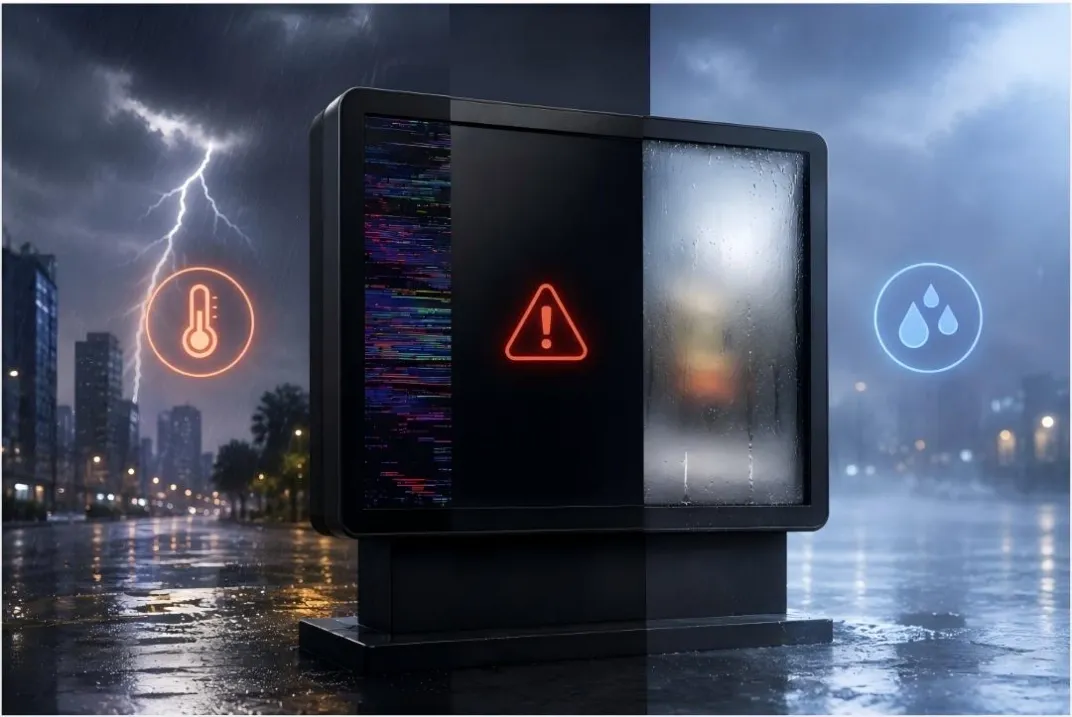
When fog appears behind the glass, water ingress is an obvious concern, but condensation caused by temperature change is another possibility. Condensation forms when a surface temperature falls below the dew point.
A rapid temperature drop can bring an internal surface below the dew point, causing water vapor to condense. Fog appears on the inside of the glass. In severe cases, water droplets may even form.
What is the difference between air cooling, air conditioning and heat exchange?
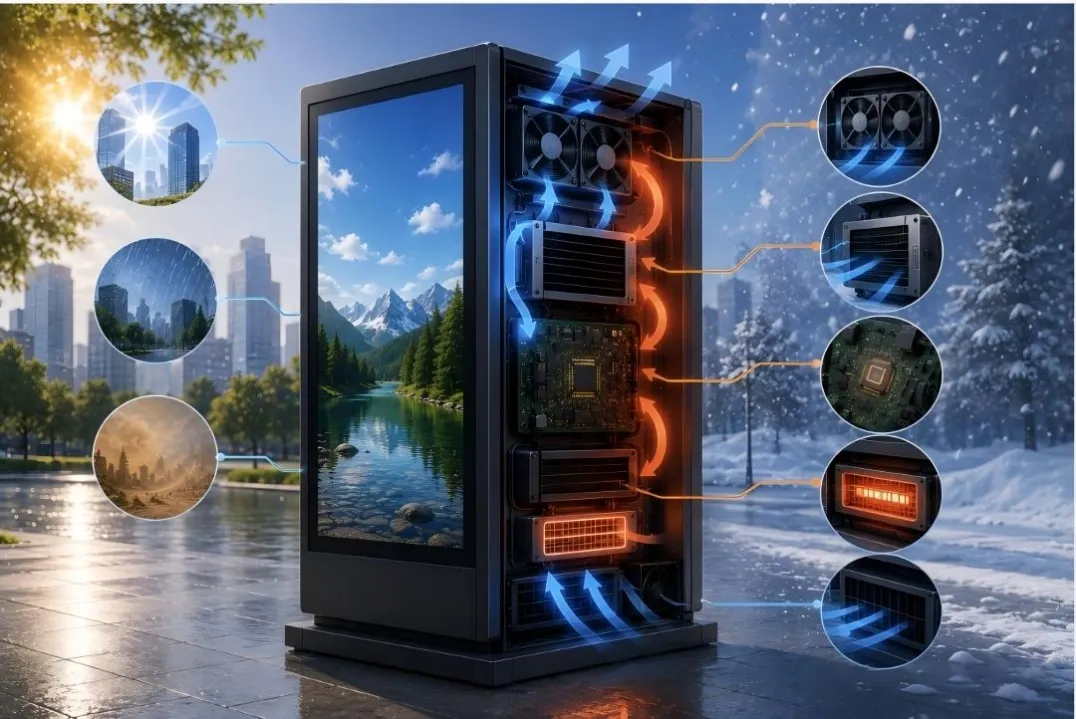
In order to control the temperature, outdoor digital signage usually uses different solutions.
Fan-Cooling System
Fan cooling is common and comparatively simple to maintain. It moves heat out of the cabinet but has limited capacity in extreme ambient conditions.
Air-Conditioning System
Air-conditioning is used for high-backlight loads, large screens or hot climates. It offers stronger temperature control but adds energy use and maintenance complexity.
Heat-Exchange System
A closed-loop heat exchanger transfers heat without directly introducing outside air, helping reduce dust entry while preserving cabinet separation. Its tradeoff is a more complex and costly structure.
What does the temperature control system really control?
A temperature-control system does more than reduce heat; it manages the working environment of the entire equipment. This includes temperature, humidity, air volume and airflow path. Its goal is not to make the device cold. Instead, the device is always in a reasonable state.
Why Can Similar Configurations Have Different Service Lives?
Operators may find that two digital signage displays with almost the same parameters. A few years later the situation was completely different. The reason often lies in the temperature control system.
This is because the display effect can be simulated in a short time. Temperature control capability needs long-term verification. This is why high-quality truly excellent outdoor equipment, a lot of cost is invested in invisible areas.
Outdoor digital signage is therefore also a heat-management system. In practical terms, for indoor display equipment, the display system is the core. For outdoor digital signage, the thermal management system is equally important.
In demanding environments, thermal management can be as important as the display system because no matter how good the picture is, it must be based on stable operation. In conclusion, what many people see is the screen. What engineers see is temperature. Because what determines the life of outdoor digital signage is often not resolution. Not brightness. Not even the panel brand.
The key question is whether the equipment remains stable through high temperature, low temperature, rapid temperature change and extended operation. Outdoor digital signage is not only a display; it is an engineered system that must continually manage heat.